Rules or Ritual


Friends, somebody in your life owes you an apology right now. Maybe it was a small grievance—like they never texted you back, or they said something stupid last Thanksgiving. Maybe it was something bigger, like betrayal or abuse. Regardless of where the offense may fall on the spectrum of hurt, we can all quickly bring to mind someone who offended us.

If you're like me, you didn't have to think too hard about who wronged you. The list of my grudges and resentments—of the people I've bound—is a list I can easily access. I keep it close. The people on it have disappointed me, failed me, or betrayed me, and they deserve to be on the list. Now, whether they care that they're on my list is another story. In truth, they probably don't even know about it.
My sisters and brothers in recovery say clinging to resentment is like drinking poison and waiting for the other person to get sick. If they're right, then my list actually hurts me. In the process of trying to bind others, I end up bound. What my siblings in recovery do not say, however, is that emotional pain or conflict is avoidable. The writer of Matthew's gospel seems to agree. It contains no instruction about avoiding conflict—no guidance on how to get along with everyone all the time. Much like the wisdom of recovery, Matthew's gospel presumes conflict is going to happen. It assumes that people are going to hurt each other.
In fact, the text of Matthew 18 seems to be addressing my list directly:
If your brother or sister hurts you,
go and confess the hurt when the two of you are alone.
If you are listened to, you have regained that one.
But if you are not listened to, take one or two others along
so that the presence of witnesses will keep things honest, and try again.
If that person still refuses to listen, tell the church.
If the offender refuses to listen even to the church,
let them be to you as a gentile and a tax collector (Mt. 18:15-17).
It's pretty cut and dry, right? This is divine instruction on how to manage a list; the Jesus rules for resolving conflict.
• Confront them privately—CHECK!
• Bring witnesses—CHECK!
• Take it to the church—CHECK!
• They still won't budge? No problem, treat 'em like a tax collector—CHECK!
The offender can confess and repent or refuse and get discarded. It's completely up to them—but one way or another, they're getting crossed off my list.
That's why we love quoting these verses in a fight. Because they help manage our lists of all the people who are wrong. You may have even had these verses quoted at you. I've definitely been told, “You need to have a Matthew 18 conversation.” We love reminding each other about these rules. In fact, that might be what we do best with the biblical library—remind each other about the rules. We all know that if we'll just follow God's rules, we'll get the desired result.
These are the rules that should allow me to win a fight, or, if necessary, get rid of somebody with a clean conscience. If I follow these Matthew 18 rules, I should get the desired result. So, why don't I feel any better? I've been following these rules for decades. Why am I still holding grudges and clinging to resentments? Why do I still have a list?
In his 1926 work, Religion in the Making, philosopher and mathematician Alfred North Whitehead described how religion comes into existence. The first step is ritual. Before our religious language, before our doctrines and rules, we create rituals—bodies moving together—a set of actions we repeat at the same time, in the same way. We follow the rhythm of ritual and connect to each other.

Our rituals then generate the second step—emotion. The embrace and practice of bodies moving together generates a visceral response. As we move and experience together, something within us shifts. We feel.

Our shared ritual experience and the resulting emotions then give rise to step three, which is belief. In the third step, we begin telling stories. We write poetry and songs. We employ myth to personalize unseen forces. Specific ideas and principles emerge to make sense of our experience. We're no longer just moving together or feeling. Now, we believe.

The fourth and final step is rationalization. Dr. Tripp Fuller calls it “the late-stage cleanup crew” that organizes our beliefs into systems, traditions, and denominations. Rationalization is what allows religious communities to develop and coalesce around shared beliefs and values, but as Dr. Fuller points out, if our rationalization “forgets where it comes from,” it can kill “the very thing it was trying to save.” In other words, rationalization can distort everything that came before it—our rituals, emotions, and beliefs can get lost in rules.
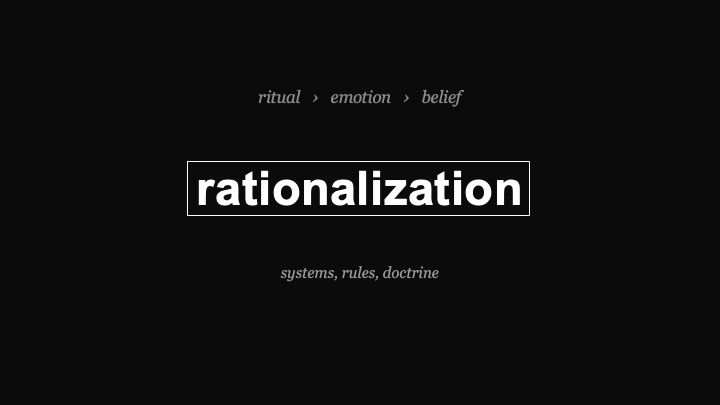
Ritual, emotion, belief, rationalization. It's important to note that in Whitehead's developmental pattern, belief and rationalization are the end—not the beginning. The journey begins in ritual. What if that's what our spiritual ancestors were doing? What if our beginning—the one they recorded in the poems, songs, and stories of the Bible—is also based in ritual?

I don't approach rituals the same way I approach rules. I have different expectations, a different mindset, a different posture. To begin, I contribute to the ritual. I have a role to play. A ritual is not a static line against which I am measured. It's active and adaptive. Rituals are something entirely different than rules.
Rules transact. Rituals transform. A transaction is a deal. You caused the hurt. You are the sinner. Now there must be restitution in order to make things right. Transformation is not a deal at all. It's a metamorphosis. Like a caterpillar becoming a butterfly, we wind up completely different.

Rules transfer. Rituals transport. To transfer means something moves from me to you. I transfer the blame. I hand off the guilt. I'm right; you're wrong. Transporting is different because the blame doesn't move—we do. Bodies moving together from one place to another.

Rules transfix. Rituals transcend. When we transfix something, we nail it to the wall. We define it, and we bind it. We pin it down like a butterfly in a display case. When we transcend something, the edges blur. Boundaries get loosed. The butterfly is experienced, but it remains alive and unpredictable.

To be fair, rules aren't always bad. They do have application. But a problem arises when we attempt to use rules to contain the uncontainable. As theologian Peter Rollins describes, God is the “ineffable Source that is received but never conceived.” No matter how hard we may try, or how earnestly we may believe, God—the ultimate reality—can neither be contained by our ideas, nor shared by our rules. When we rationalize otherwise, we create religions with followers who can hear a message without heeding it. When we flatten our sacred scriptures into a divine rulebook, we can listen to the truth, we can even agree with it, but we're not changed by it.
A ritual, on the other hand, contains the potential to change the way we hold reality—to realign what we perceive as real. In a sense, rules exist to measure us—comparing our beliefs and behaviors—while rituals exist to reconnect us—regardless of what we bring to the table.
Rules compare; rituals don't care. Whether we show up focused on self, pursuing comfort, or locked in resentment, the ritual remains non-reactive—taking whatever we bring and inviting us to lift up our gaze and look beyond. The lighting of candles, the recitation of the Shema, raising our voices together in song—rituals employ small actions and symbols to point toward something big. Conversely, rules constrain. They restrict. They place something big in a smaller box.
If we're going to hold these five verses in Matthew as rules, that's exactly what we'll have to do—place them in a smaller box and isolate them from the rest of the story. Immediately preceding these verses, Jesus tells a parable of a shepherd who leaves a flock of 99 to look for the one sheep who wandered off.

Following these verses, Jesus tells a cautionary parable about a servant, who after being forgiven an inescapable debt by his ruler, turned around and threw someone who owed him a much smaller amount in jail.

And if we're still not connecting the dots, immediately after these verses, Matthew has Peter bluntly ask Jesus: “How many times am I supposed to forgive someone? Is seven times enough?” Jesus responds, “Not seven times, but seven times seventy”—which, to be sure, is not a mathematical rule but a symbolic way of saying “as many times as they need” (Mt. 18:21-22).
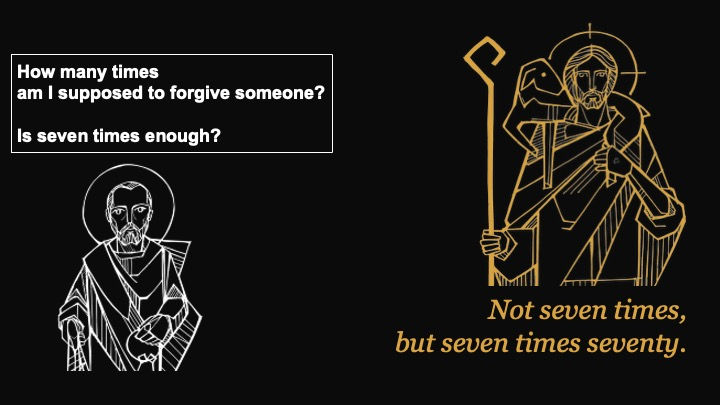
That's the setting for these five verses: lost sheep rescued, insurmountable debt forgiven, limitless mercy, and people—like Peter, like the unforgiving servant—who still don't seem to get it. People looking for rules. People with lists—like me. If I want these five verses to be rules, I have to ignore all that context.

When I do that—when I disregard the larger story and isolate these verses—the person who hurt me is not connected to me—they're “other,” and the point of each step is to pin them down and win. The honor of a private conversation gets flattened into a crusade. Adding witnesses mutates into army-building. Communal wisdom is reduced to a public trial, and I ultimately have permission to discard those who won't listen. As theologian Dr. Jin S. Kim writes, these five verses quickly and “easily become dangerous and abusive.” As rules, they work best for whoever has the most power—and that should make us nervous. As rules, they exist to solidify difference—to separate the compliant and qualified from the noncompliant and disqualified.
If, however, we recognize Matthew 18 as ritual, these verses exist to dissolve difference—to bring the reality of our inseparable relationship into focus. To paraphrase the teaching of Father Richard Rohr, “The only thing that separates us from each other is the idea that we are.” In the ritual of Matthew 18, no one is “other,” and the point of each step is reconnection—bodies moving together, crossing over perceived separation, feeling and remembering that we are one. And rather than giving permission to discard those who won't listen, the ritual ultimately confesses that it might not work. Our best intentions may not be enough to restore relationship. Some hurt, some disconnection, exists beyond the reach of this ritual.
If the offender refuses to listen, let them be to you as a gentile and a tax collector (Mt. 18:17).

Don't miss that ritual-ending pivot. We are in the Gospel of Matthew. Matthew—who, earlier in this very story, is identified as a tax collector. Matthew the tax-collector records this ritual. Matthew the tax-collector—someone who would have been on a lot of people’s lists—ends the ritual with the words: “Let them be to you as a gentile and a tax collector.”

Friends, I submit to you that is not a rule for discarding someone.

That is a wink and a smile from an outsider brought in—a tax-collector who remembers. Matthew knows that whether someone wanders off like a lost sheep, acts like an idiot who completely misses the point, or refuses to listen to you and everyone else, that's not the ritual failing. That is the cost of love. People are free to say no.

But even then—even when the relationship is not regained—the ritual transcends. It still asks something of us. It doesn't require us to pretend like everything is okay. It doesn't pressure us to reconcile at all costs. It invites us to remember our tax-collecting ancestor and recognize that if the ones who hurt us can't change, then our list must. Rather than an accounting of people who owe us an apology, it's transformed into a list of people who don't yet see, who can't yet hear—a list of people who, perhaps for reasons and traumas unknown to us, believe themselves to be on the outside—disconnected and separate.

Matthew the tax collector knows what that's like. Matthew the tax collector knows firsthand how God treats people like that. They don't get crossed off the list. They get invited to dinner—just like Matthew. In beloved community, no one is unworthy—not the wrong, not the stubborn, not even those who hurt us. None are expendable. If even one sheep remains lost in the illusion of separation, we are not yet whole.
So, we share a meal. Bodies moving together, transported to the table—small actions that allow us to catch a glimpse of something bigger. As luck would have it, we've got a ritual for that, too.
Come, and remember that we are one.
This piece is also available on the Darrell Smith Teaching Podcast. Click here to listen!


Comments